How to Order Food in Korea: A First-Timer’s Guide to Menus, Kiosks, and Payment
Ordering food may be one of the most exciting parts of a trip to Korea, but it can also feel surprisingly stressful the first time.
You may enter a restaurant and see a menu written mostly in Korean. The staff may point toward a kiosk instead of taking your order. A tablet may already be attached to the table, or you may be expected to order and pay at the counter before sitting down.
The good news is that you do not need to speak fluent Korean to enjoy restaurants in Seoul.
Once you understand the most common ordering systems, know a few useful menu words, and recognize what usually happens at payment, eating in Korea becomes much easier.
This guide explains how to order food in Korea step by step, including how to read menus, use restaurant kiosks, order from staff, choose beginner-friendly Korean dishes, ask for help, and pay after your meal.
Restaurant systems can vary by location, branch, and business type, so treat this as a practical general guide rather than a fixed rule for every restaurant.
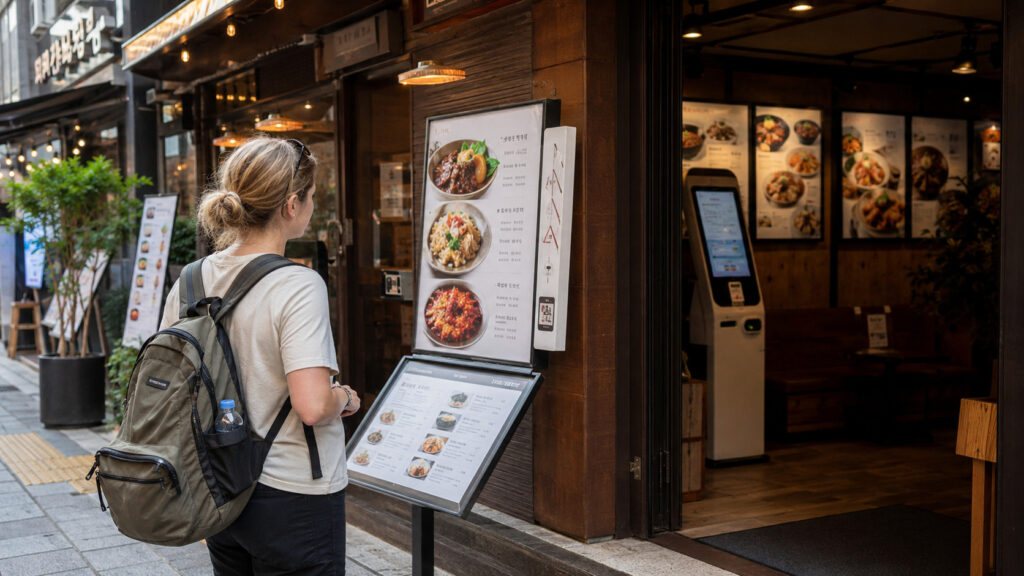
Table of Contents
Is It Difficult to Order Food in Korea?
For most travelers, ordering food in Korea is easier after the first one or two meals.
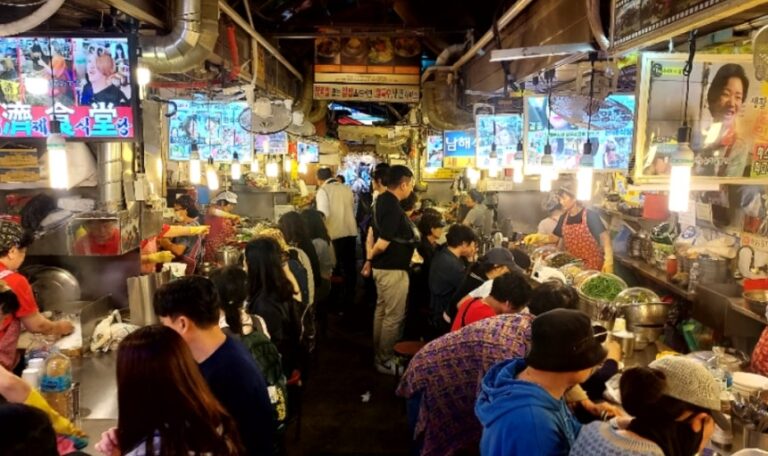
Many restaurants in popular areas such as Myeongdong, Hongdae, Gangnam, Seongsu, and central Seoul have picture menus, English menu descriptions, kiosks, or staff who are familiar with international visitors.
However, smaller local restaurants may have limited English information. You may also find different ordering systems at restaurants that look very similar from the outside.
The most common methods are:
- Ordering from a server at your table
- Ordering and paying at a counter
- Ordering from a self-service kiosk
- Ordering with a tablet attached to the table
- Scanning a QR code and ordering on your phone
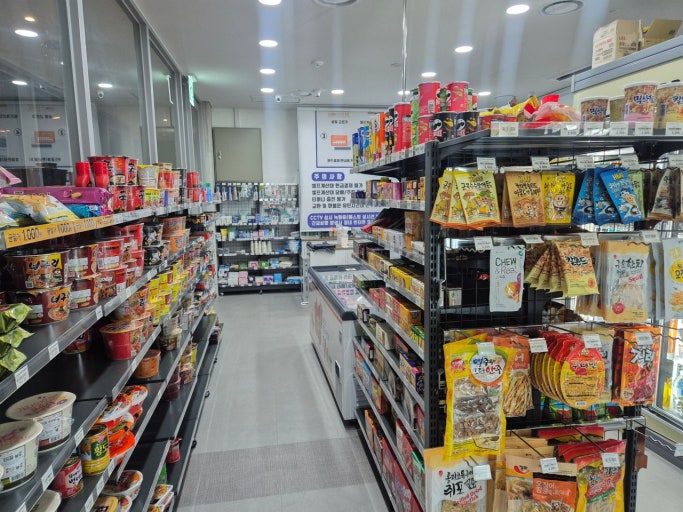
Self-service water stations, side-dish refill areas, and unmanned ordering machines have become common at many Korean restaurants. Do not worry if you do not immediately understand the system. Pause near the entrance, look for a kiosk or counter, and watch what other customers are doing..
How to Order Food in Korea: The Basic Flow
Although every restaurant is different, a typical meal follows this general process:
- Check whether you should wait to be seated or choose a table.
- Find out whether ordering happens at the table, counter, kiosk, or tablet.
- Look at the menu and check prices, serving sizes, and minimum-order rules.
- Order your food and select any required options.
- Keep your receipt or remember your order number if needed.
- Check whether water, utensils, or side dishes are self-service.
- Eat your meal.
- Pay at the counter unless you already paid when ordering or the restaurant uses table payment.
Do not assume that every restaurant uses the same system.
A small noodle shop may take your order at the table and ask you to pay at the counter afterward. A food court may require payment before you receive a buzzer. A café-style restaurant may give you an order number and ask you to collect your own food.
The easiest approach is to look for clues before sitting down.
Before Entering a Restaurant
Before choosing a restaurant, check a few practical details.
Look for:
- Current opening hours
- Recent menu photos
- Updated prices
- Whether the restaurant accepts solo diners
- Whether reservations are required
- Whether there is a minimum order
- Whether the restaurant is inside a building, basement, or upper floor
Restaurant information can change, especially when there are multiple branches. Check the exact location you plan to visit rather than relying only on an old blog post or social media video.
How to Use Naver Map in Korea: A Beginner-Friendly Guide for Foreign Travelers
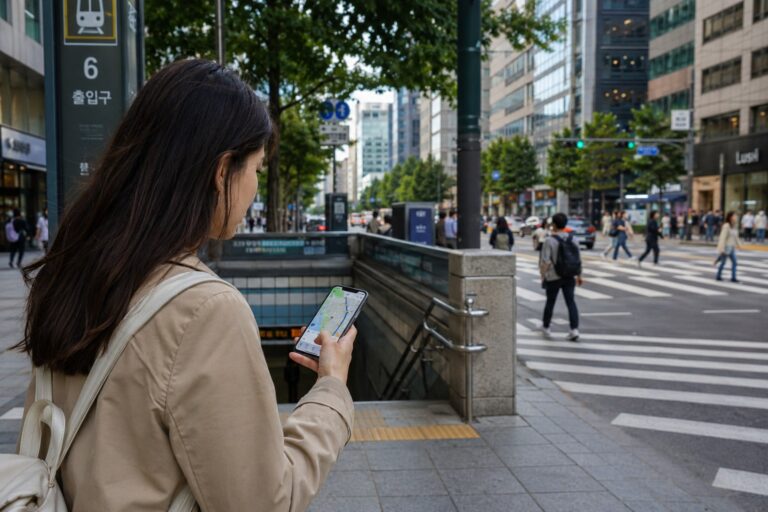
Naver Map is useful for checking Korean addresses, recent restaurant photos, opening hours, nearby subway exits, and the walking route from your hotel or sightseeing destination. The exact app information can still change, so check recent updates before visiting.
Do You Have to Wait to Be Seated?
At many restaurants, staff will show you to a table.
At smaller casual restaurants, you may be able to choose an open seat. However, do not automatically walk past waiting customers or sit at a reserved table.
When the restaurant is busy:
- Look for a waiting list or tablet near the entrance.
- Check whether customers are entering their phone numbers.
- Look for staff instructions.
- Wait near the entrance rather than blocking the doorway.
Some waiting systems may require a Korean phone number. If you cannot use the system, politely ask a staff member for help.
Useful Phrase
One person, please.
한 명이요.
Han myeong-iyo.
For two people:
두 명이요.
Du myeong-iyo.
How to Read a Korean Menu
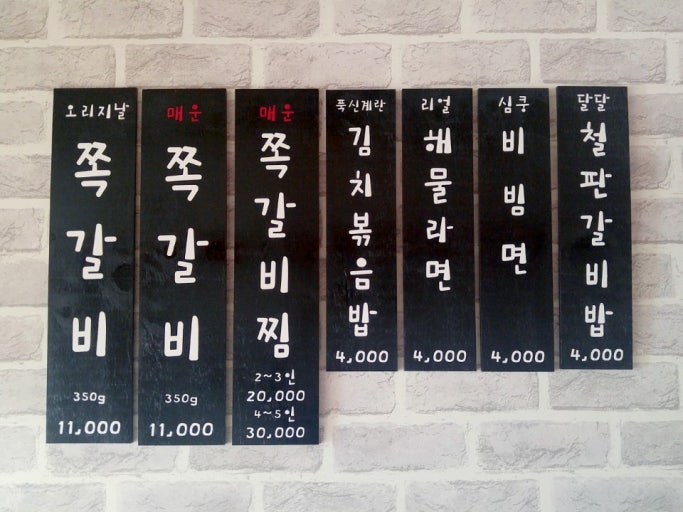
A Korean menu may look confusing at first, but you do not need to translate every word.
Start with four things:
- The photo
- The main dish name
- The price
- The serving or minimum-order information
Useful Korean Menu Words
| Korean | English Meaning |
|---|---|
| 메뉴 | Menu |
| 대표 | Signature item |
| 추천 | Recommended |
| 인기 | Popular |
| 1인분 | One serving |
| 2인분 | Two servings |
| 2인 이상 | Two or more people |
| 세트 | Set menu |
| 단품 | Individual item |
| 추가 | Extra or add-on |
| 수량 | Quantity |
| 품절 | Sold out |
| 매운맛 | Spicy flavor |
| 순한맛 | Mild flavor |
| 포장 | Takeout |
| 매장 | Dine-in |
| 공깃밥 | Bowl of rice |
| 공깃밥 별도 | Rice sold separately |
Understand the Difference Between People and Servings
This is one of the most important menu details.
1인분 means one serving.
However, some restaurants require at least two servings for grilled meat, hot pot, large stews, or dishes designed for sharing.
For example:
2인분 이상 주문
This usually means you must order at least two servings.
That does not always mean each customer must order two servings. It means the table may need to meet the restaurant’s minimum order.
The exact rule is restaurant-specific and should be confirmed before ordering.
Check Whether the Price Is Per Serving
At Korean BBQ restaurants, the price shown may be for one serving rather than the entire plate for the table.
The menu may also show a weight such as:
- 150 g
- 180 g
- 200 g
Before ordering, check:
- Price per serving
- Number of servings required
- Meat weight
- Whether rice is included
- Whether side dishes are included
Solo Dining in Seoul: Best Restaurants for First-Time Visitors
Solo travelers should pay extra attention to minimum-order rules because some shared dishes are easier to order with two or more people.
How to Translate a Korean Menu
When an English menu is not available, a translation app can help.
You can use your phone camera to translate:
- Printed menus
- Menu boards
- Kiosk screens
- Table signs
- Self-service instructions
Papago offers image translation functions that can be useful for Korean menu photos and screenshots.
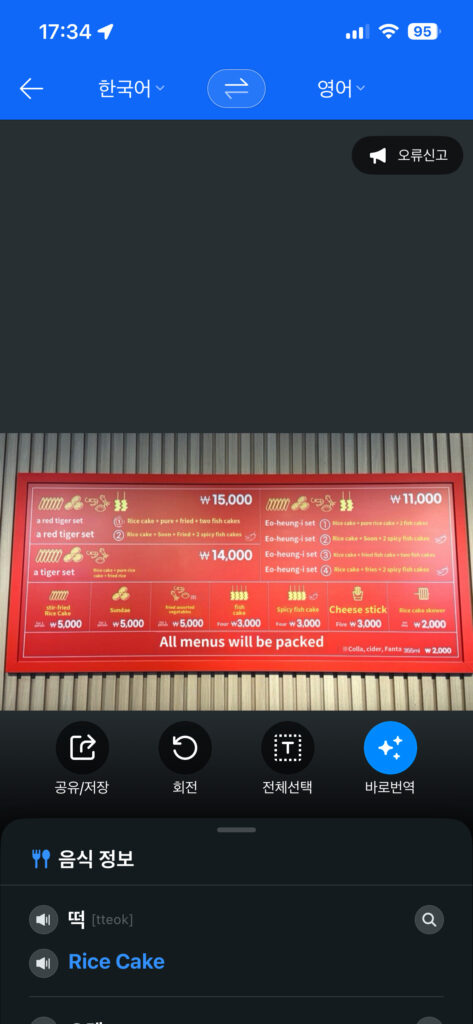
A practical method is:
- Take a clear photo of the menu.
- Open the image translation function.
- Select Korean as the original language.
- Translate the image into English.
- Compare the translated text with the menu photo and price.
Translation apps are helpful, but translations may not always explain ingredients correctly.
For example:
- A soup name may be translated literally rather than describing the broth.
- A menu may contain seafood stock even when seafood is not mentioned in the English name.
- “Vegetable” does not automatically mean vegetarian.
- “Mild” does not always mean completely non-spicy.
For serious allergies or strict dietary requirements, do not rely only on automatic translation. Confirm ingredients with staff and remember that cross-contact information may not be available.
How to Order from a Restaurant Server
Traditional table ordering is still common in Korea.
After you sit down, the server may give you a menu and return after a few minutes.
You can order by:
- Saying the menu name
- Pointing to the menu
- Showing a menu photo
- Holding up your fingers to show the quantity
- Using a translation app
You do not need to pronounce every Korean dish perfectly.
Pointing to the correct menu item and saying “This one, please” is usually enough.
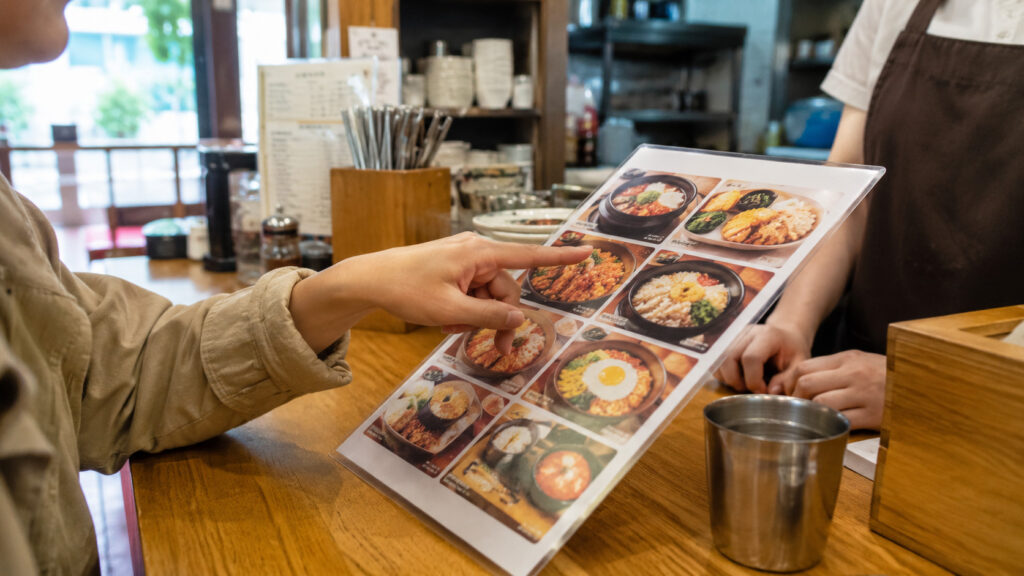
The Most Useful Ordering Phrase
이거 주세요.
Igeo juseyo.
Meaning:
This one, please.
You can point at a menu photo while saying it.
For two of the same item:
이거 두 개 주세요.
Igeo du gae juseyo.
Meaning:
Two of these, please.
How to Call a Server
Many Korean restaurant tables have a call button.
The button may say:
- 호출
- 벨
- CALL
Press it once and wait.
You do not need to press it repeatedly.
If there is no button, you can politely say:
저기요.
Jeogiyo.
This is similar to saying:
Excuse me.
Say it loudly enough for the staff to hear, but there is no need to shout across the restaurant.
Confirm the Order Before the Server Leaves
After ordering, quickly check:
- Number of dishes
- Number of servings
- Spicy or mild option
- Rice or noodle add-ons
- Drinks
- Any extra toppings
This is especially useful when ordering Korean BBQ, hot pot, fried chicken, or set menus.
How to Order Food in Korea at a Restaurant Kiosk
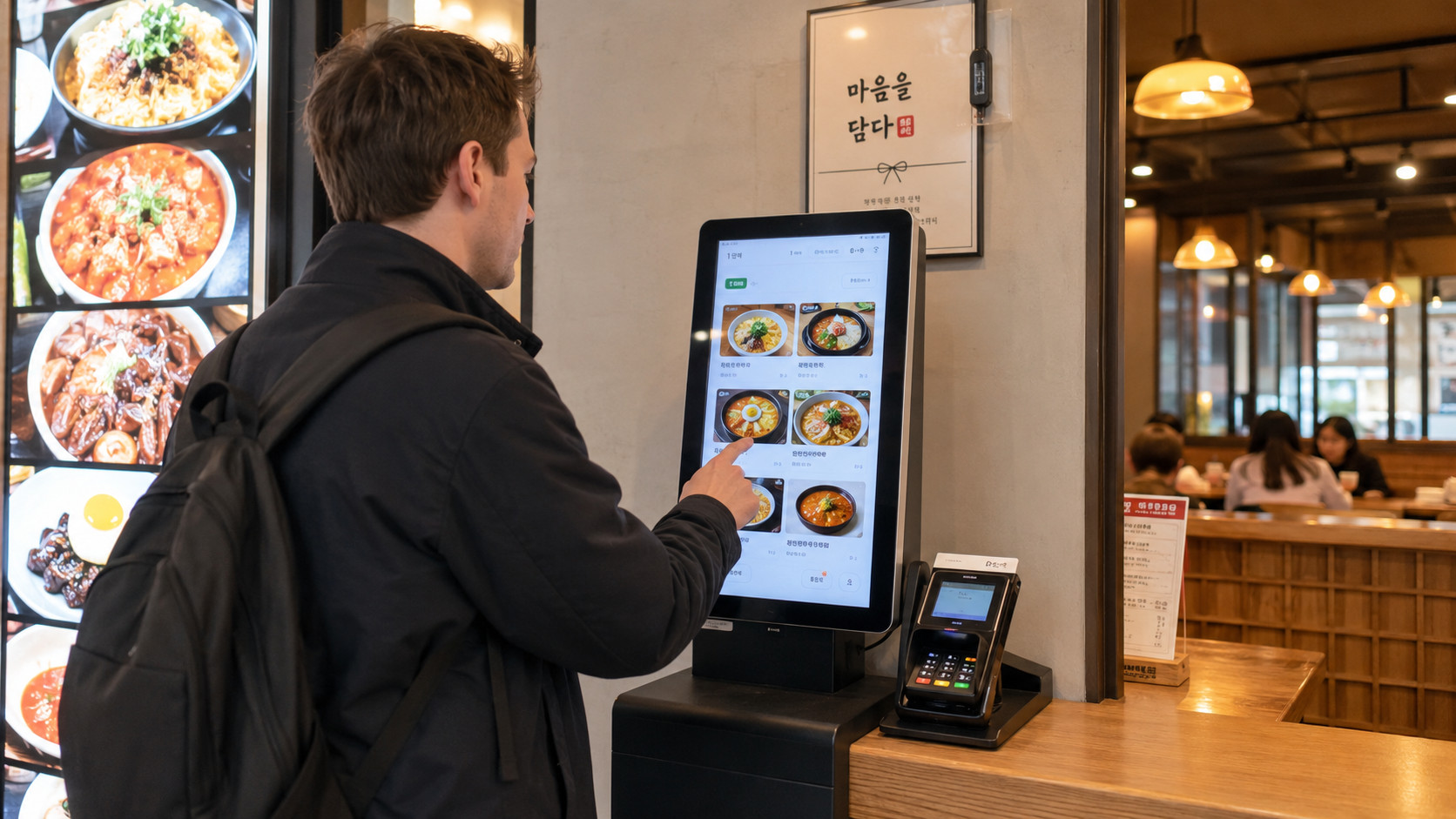
Learning how to order food in Korea becomes much easier once you recognize the basic steps used by most restaurant kiosks.
Restaurant kiosks are common at fast-food restaurants, food courts, casual chains, cafés, and some local restaurants.
The exact design changes by brand and machine, but the basic process is usually similar.
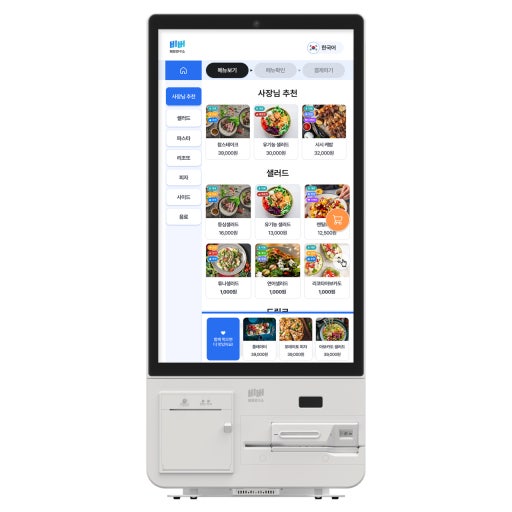
Step 1: Look for the Language Button
Check the top corners or bottom area of the screen.
You may see:
- English
- 한국어
- 中文
- 日本語
- Language
- A globe icon
Not every kiosk has English, and translated menus may contain fewer details than the Korean version.
Step 2: Choose Dine-In or Takeout
Common options include:
| Korean | English |
|---|---|
| 매장 | Dine-in |
| 매장 식사 | Eat in the restaurant |
| 먹고 가기 | Eat here |
| 포장 | Takeout |
| 가져가기 | Take away |
Choose carefully because packaging and order numbers may be different.
Step 3: Choose a Menu Category
Common categories include:
- Main dishes
- Set menus
- Drinks
- Side dishes
- Desserts
- Additional items
Select the category and then choose the item you want.
Step 4: Check Required Options
Some kiosks ask you to choose:
- Size
- Spicy level
- Sauce
- Side dish
- Drink
- Extra topping
- Rice or noodles
- Dine-in or takeout packaging
Do not press the final payment button too quickly.
Check whether the option is included or costs extra.
Step 5: Check the Quantity
Look for:
- Quantity
- 수량
- Plus and minus buttons
- Shopping cart
- 장바구니
Make sure you did not accidentally add the same dish twice.
Step 6: Review the Order
Before paying, check:
- Menu items
- Quantity
- Options
- Total price
- Dine-in or takeout selection
Step 7: Pay
Insert, tap, or swipe your card according to the machine instructions.
Credit cards are accepted at most restaurants and many other businesses in Korea, including major international card brands. However, acceptance at one particular kiosk, market stall, or payment terminal should never be assumed.
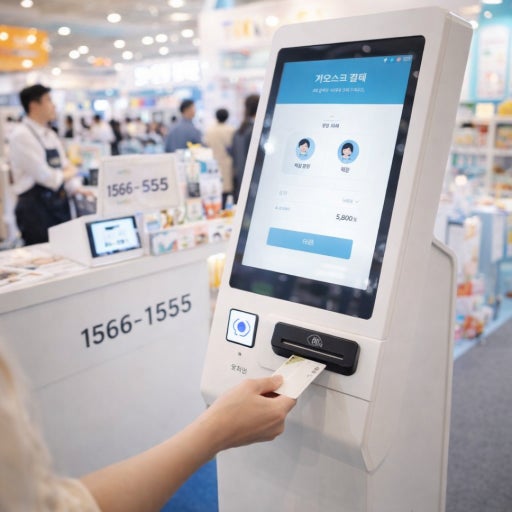
If your foreign card does not work:
- Remove the card and try again.
- Check whether the card should be inserted rather than tapped.
- Try another credit or debit card.
- Ask staff whether you can pay at the counter.
- Use cash if the restaurant accepts it.
A failed payment does not necessarily mean your card is blocked. The issue may be related to the terminal, kiosk, card settings, or payment network.
Carry a backup card and a small amount of Korean won rather than depending on only one payment method.
Step 8: Take the Receipt
Do not walk away immediately after payment.
Check whether you receive:
- A receipt
- An order number
- A pickup number
- A buzzer
- A table number request
Your number may appear on a screen or be called by staff.
How to Order with a Table Tablet or QR Code
Some Korean restaurants use tablets attached to the table.
The tablet may allow you to:
- Change the language
- View menu photos
- Add dishes to a cart
- Order additional food
- Call staff
- Request water or side dishes
- Check the current bill
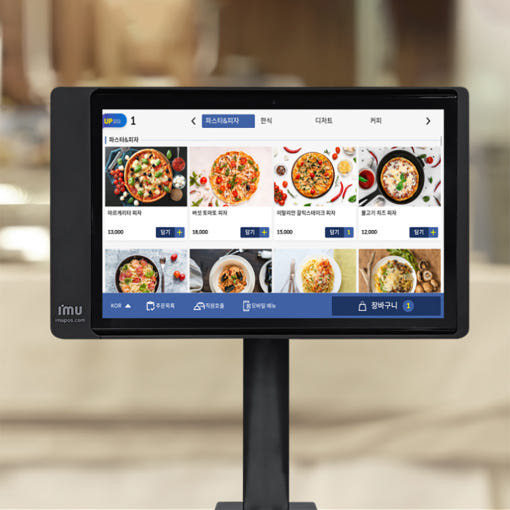
A typical process is:
- Select English if available.
- Choose a menu category.
- Select a dish.
- Check options and quantity.
- Add the item to the cart.
- Review the order.
- Press “Order” or “Place Order.”
- Wait for an order confirmation screen.
Do not assume that adding food to the cart completes the order.
Look for a final confirmation button.
QR Code Ordering
Some restaurants place a QR code on the table.
After scanning it:
- Open the restaurant menu.
- Select a language if available.
- Choose your food.
- Confirm the table number.
- Submit the order.
- Check whether payment happens online or at the counter.
QR ordering systems vary significantly, and foreign phone numbers or overseas payment methods may not work with every service.
If the system becomes confusing, ask staff rather than repeatedly submitting the same order.
What Happens After You Order?
After ordering, check the table and nearby self-service area.
You may find:
- Water bottles
- Water dispensers
- Cups
- Spoons
- Chopsticks
- Napkins
- Extra side dishes
- Scissors
- Tongs
- Aprons
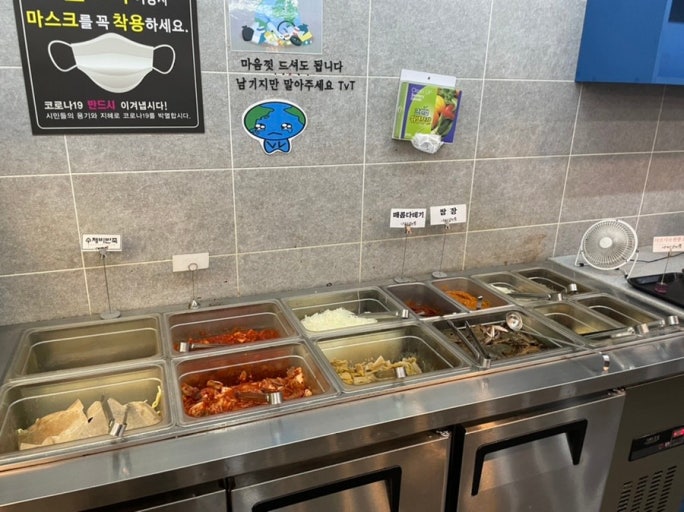
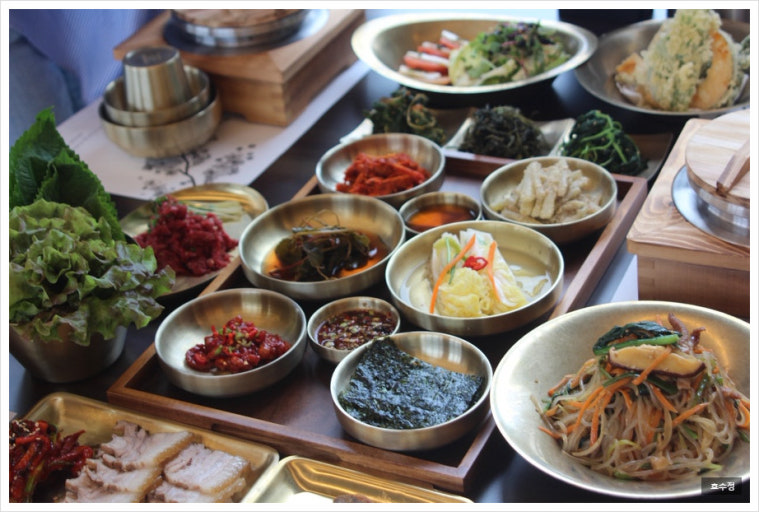
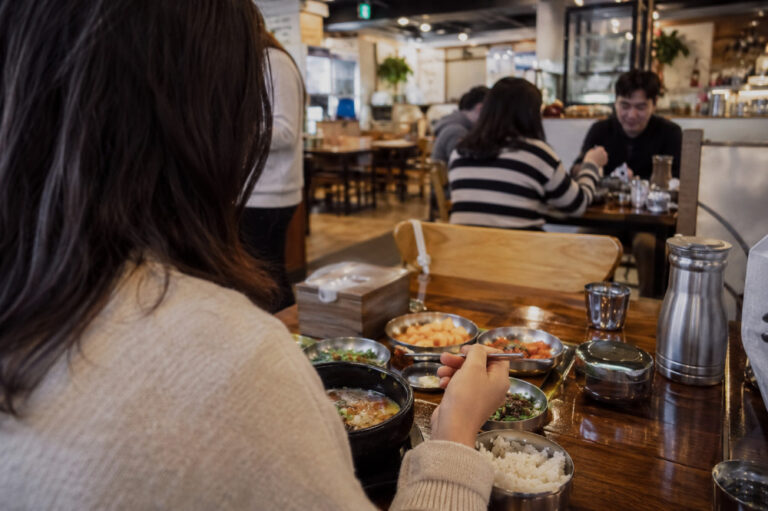
Many restaurants provide water and basic side dishes with the meal, and some allow customers to collect additional water or standard side dishes from a self-service area. Do not assume that every extra item is free.
Extra meat, noodles, cheese, rice, eggs, premium side dishes, and separately listed menu items usually cost extra.
Look for:
셀프
This means:
Self-service
Food May Not Arrive at the Same Time
At casual restaurants, dishes may be served as soon as they are ready.
One person may receive food before another person.
This does not necessarily mean the other order was forgotten.
Wait a few minutes, especially when your group ordered different types of food.
Should You Wait Before Eating?
You do not need to wait for every dish if the food will become cold or continue cooking.
For shared meals, follow the table naturally.
At Korean BBQ restaurants, staff may cook the meat for you. If staff begins grilling and cutting the meat, allow them to manage the grill unless they tell you otherwise.
Beginner-Friendly Korean Foods to Order
Your first meal in Korea does not need to be the most adventurous dish.
Choose something that fits your comfort level, group size, and dietary needs.
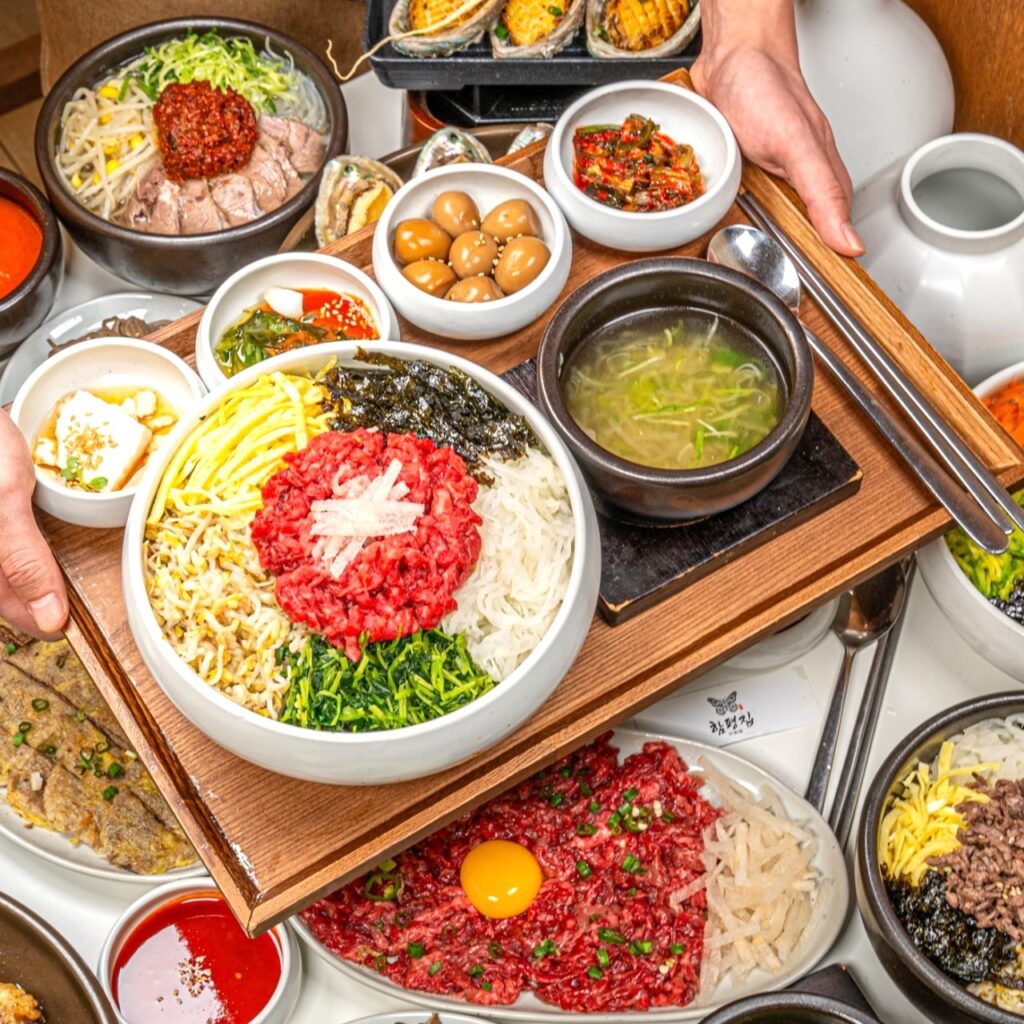
1. Bibimbap
Bibimbap is rice topped with vegetables, egg, meat, and sauce.
Why it is beginner-friendly:
- Usually ordered as one individual meal
- Easy to understand visually
- Ingredients are separated before mixing
- Easy to eat alone
Things to know:
Gochujang sauce can be spicy. Add a small amount first rather than mixing all of it immediately.
Best Bibimbap in Seoul for Tourists: 7 Restaurants, Ordering Tips, and What to Choose
2. Bulgogi
Bulgogi is thinly sliced meat cooked with a sweet and savory seasoning.
Why it is beginner-friendly:
- Familiar sweet-savory flavor
- Usually less spicy
- Easy to eat with rice
Things to know:
Serving style varies. Some restaurants serve bulgogi as a shared dish, while others offer individual meals.
3. Kalguksu
Kalguksu is a noodle soup with knife-cut wheat noodles.
Why it is beginner-friendly:
- Warm and filling
- Often mild
- Common at traditional markets and casual restaurants
- Usually easy to order as one meal
Things to know:
The broth may contain anchovy, shellfish, or other seafood ingredients.
4. Gomtang or Seolleongtang
These are mild Korean beef soups served with rice.
Why they are beginner-friendly:
- Usually not spicy
- Simple flavor
- Easy for solo dining
- You can often season the soup to your own taste
Things to know:
Kimchi served on the side may be spicy.
5. Mandu
Mandu are Korean dumplings.
Why they are beginner-friendly:
- Easy to recognize
- Available steamed, boiled, or fried
- Good as a snack or side dish
Things to know:
Fillings may contain pork, beef, tofu, vegetables, or seafood.
6. Gimbap
Gimbap is rice and fillings rolled in seaweed.
Why it is beginner-friendly:
- Quick and affordable
- Easy for takeout
- Useful for travel days
- Common at casual restaurants
Things to know:
Some varieties contain ham, fish cake, egg, tuna, or processed meat.
7. Samgyetang
Samgyetang is a whole young chicken served in a hot soup with rice.
Why it is beginner-friendly:
- Mild flavor
- Filling individual meal
- Traditional Korean food experience
Things to know:
The chicken contains bones, and the soup is served very hot.
Popular Foods That May Be More Challenging
Korean BBQ is an excellent experience, but some restaurants require a minimum of two servings.
Tteokbokki is famous but can be much spicier than first-time visitors expect.
Large stews and hot pots may be designed for sharing.
Raw seafood, fermented dishes, or strongly seasoned foods may be better after you understand your preferences.
15 Must-Try Korean Foods in Seoul for First-Time Visitors: What to Eat and How to Order
Best Non-Spicy Korean Restaurants in Seoul for First-Time Visitors
How to Pay at a Korean Restaurant
Understanding how to order food in Korea also means knowing whether you should pay before or after your meal.
Payment timing depends on the restaurant.
You may pay:
- At a kiosk before eating
- At the counter before sitting down
- At the counter after eating
- At your table
- Through a tablet or QR ordering system
Do not wait for a server to bring a bill unless the restaurant appears to use table service.
At many casual Korean restaurants, customers walk to the counter after eating.
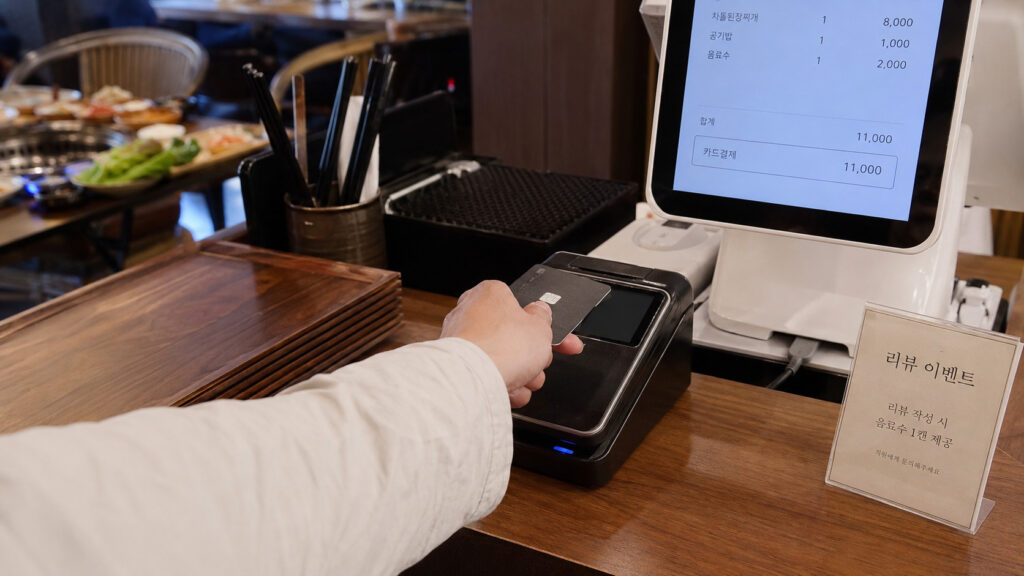
What Should You Take to the Counter?
Depending on the restaurant, bring:
- Your receipt
- A table bill
- A table number card
- Nothing, if staff can identify your table
If you are unsure, point toward your table and say:
계산할게요.
Gyesanhalgeyo.
Meaning:
I would like to pay.
Can You Use a Foreign Credit Card?
Major credit cards are widely accepted at restaurants, hotels, stores, and tourist destinations in Korea. However, a specific kiosk may reject a foreign card.
- A small market stall may prefer cash.
- Contactless payment may not work even when inserting the card works.
- Your bank may block an overseas transaction.
Bring:
- One main card
- One backup card
- A small amount of cash
Can You Pay with T-Money?
Do not assume that a T-Money transportation card works as a general restaurant payment card.
Some participating merchants may accept it, but availability varies.
For restaurant meals, prepare a regular credit card, debit card, or cash unless the store clearly displays T-Money acceptance.
T-Money Card Guide for First-Time Visitors to Korea
Do You Need to Tip in Korea?
Tipping is generally not expected at Korean restaurants. Official tourism information states that tipping is not normally required, although some upscale hotels or restaurants may include a service charge. If a paper bill is left on your table, take it to the counter when you are ready to leave and pay the amount shown on the bill.
Useful Korean Phrases for Ordering Food
You do not need to memorize a long list.
These phrases cover many common restaurant situations.
| Korean | Pronunciation | English |
|---|---|---|
| 이거 주세요 | Igeo juseyo | This one, please |
| 하나 주세요 | Hana juseyo | One, please |
| 두 개 주세요 | Du gae juseyo | Two, please |
| 한 명이요 | Han myeong-iyo | One person, please |
| 두 명이요 | Du myeong-iyo | Two people, please |
| 안 매워요? | An maewoyo? | Is it not spicy? |
| 덜 맵게 해주세요 | Deol maepge haejuseyo | Please make it less spicy |
| 물 주세요 | Mul juseyo | Water, please |
| 포장해 주세요 | Pojanghae juseyo | Please make it takeout |
| 계산할게요 | Gyesanhalgeyo | I would like to pay |
| 감사합니다 | Gamsahamnida | Thank you |
Remember that not every dish can be made less spicy.
If spice level cannot be changed, choose another dish rather than assuming the kitchen can remove the sauce.
Situations First-Time Visitors Should Avoid
Most restaurant experiences in Seoul are straightforward, but a little caution can prevent confusion.
Avoid Ordering Before Checking the Price
Always check the menu price before ordering.
Seoul tourism guidance also recommends confirming restaurant or street-vendor prices before making a purchase. At street food stalls, check whether the displayed price is:
- Per item
- Per skewer
- Per portion
- Per plate
- Based on weight
Avoid Ignoring Minimum-Order Rules
Do not sit down at a BBQ or hot-pot restaurant and assume that one serving is always enough.
Check:
- Minimum number of servings
- Minimum number of customers
- Required set-menu size
- Table charge
Restaurant-specific policies are not confirmed until you check the current menu or ask staff.
Avoid Assuming Every Red Dish Has the Same Spice Level
A red sauce can be mildly sweet or extremely spicy.
Do not judge only by color.
Ask about the spice level or order a small amount first when possible.
Avoid Depending on Only One Payment Method
A foreign card may work at one restaurant and fail at another kiosk.
Carry a second card and some Korean cash.
Avoid Relying Only on Automatic Translation for Allergies
Translation apps are useful for general menu understanding, but serious allergies require clearer confirmation.
If communication is uncertain, choose a restaurant with detailed ingredient information rather than guessing.
Avoid Entering Only Because Someone Is Calling Customers Inside
Staff inviting customers does not automatically mean a restaurant is bad.
However, first-time visitors should still check:
- Menu prices
- Recent reviews
- Current photos
- Minimum-order rules
Choose based on information rather than pressure.
Common Ordering Mistakes First-Time Visitors Make
Mistake 1: Sitting Down Before Checking the Ordering System
Look for a kiosk, counter, tablet, or instruction sign first.
Mistake 2: Ordering Again After Using the Kiosk
After completing kiosk payment, check the receipt and wait for your number.
Do not repeat the same order at the counter unless staff confirms that payment failed.
Mistake 3: Choosing Takeout Instead of Dine-In
Remember:
매장 means dine-in.
포장 means takeout.
Mistake 4: Thinking One Serving Means One Full Table Order
At BBQ restaurants, the listed price may be for only one serving.
Mistake 5: Adding Every Kiosk Option
Extra cheese, meat, noodles, drinks, or toppings may increase the total price quickly.
Review the final amount before paying.
Mistake 6: Waiting for a Bill at the Table
Many casual restaurants expect customers to pay at the counter.
Mistake 7: Assuming Every Side-Dish Refill Is Automatic
Check for a self-service station or politely ask staff.
Do not take food from another area unless it is clearly marked for customer use.
Mistake 8: Assuming All Korean Food Is Spicy
Korea has many mild soups, rice dishes, noodles, dumplings, and grilled dishes.
Choose based on your taste rather than avoiding Korean food completely.
How to Combine Your Meal with Seoul Sightseeing
A good restaurant plan should fit your sightseeing route.
Do not travel across the entire city for every meal unless the restaurant is one of your main trip priorities.
Myeongdong Meal + Namdaemun Market + N Seoul Tower
This is one of the easiest central Seoul routes.
Suggested order:
Myeongdong shopping → lunch or dinner → Namdaemun Market or N Seoul Tower
Myeongdong has many restaurants used to international visitors, while nearby Namdaemun offers a more traditional market atmosphere.
Jongno or Ikseondong Meal + Palaces + Insadong
Suggested order:
Gyeongbokgung Palace or Changdeokgung Palace → Insadong → Ikseondong → dinner
This route is good for combining historical sightseeing, cafés, and Korean food.
Gwangjang Market + Cheonggyecheon + Dongdaemun
Suggested order:
Gwangjang Market food → Cheonggyecheon walk → Dongdaemun Design Plaza
Market food is useful when you want to try several smaller dishes rather than sit through a long restaurant meal.
What to Eat at Gwangjang Market for First-Time Visitors
Seongsu Meal + Seoul Forest + Cafés
Suggested order:
Seoul Forest → Seongsu cafés → casual dinner
This works well when you want a relaxed afternoon instead of moving between several distant attractions.
Best Cafes in Seongsu for First-Time Visitors
Hongdae or Yeonnam Meal + Evening Walk
Suggested order:
Hongdae shopping → Yeonnam walk → casual dinner → café or nightlife
Hongdae has many casual restaurants, visual menus, and younger crowds.
Before traveling, check your route and current restaurant information on Naver Map.
Quick Ordering Checklist
Before entering:
- Check the restaurant location and opening hours.
- Look at recent menu photos.
- Check prices and minimum-order rules.
- Confirm whether the restaurant is suitable for your group size.
At the restaurant:
- Look for a kiosk, counter, tablet, or server.
- Choose dine-in or takeout correctly.
- Check quantity and extra options.
- Keep your receipt or order number.
- Look for self-service water and utensils.
Before paying:
- Check whether you already paid.
- Bring the table bill or receipt if provided.
- Use a regular payment card rather than assuming T-Money will work.
- Keep a backup card and some cash.
- Do not worry about tipping at a standard restaurant.
FAQ
1. Can I Order Food in Korea Without Speaking Korean?
Yes. Many travelers order by pointing at menu photos, using simple English, showing the quantity with their fingers, or using a translation app.
The phrase “Igeo juseyo”, meaning “This one, please,” is useful but not required.
2. Do Korean Restaurant Kiosks Have English?
Many kiosks in tourist areas, large chains, cafés, and food courts offer English.
However, not every machine has a language option, and some translated menus provide less information than the Korean version.
Use image translation or ask staff for help when necessary.
3. Can Foreign Credit Cards Be Used at Korean Restaurant Kiosks?
Many foreign Visa, Mastercard, and other major cards work in Korea, but a specific kiosk may still reject an overseas card.
Carry a backup card and a small amount of cash.
4. Do You Pay Before or After Eating in Korea?
Both systems are common.
You may pay before eating at a kiosk, counter-service restaurant, café, or food court.
At many casual sit-down restaurants, you pay at the counter after eating.
Look at what other customers are doing or ask staff.
5. Do You Need to Tip at Restaurants in Korea?
No. Tipping is generally not expected at standard Korean restaurants.
Some upscale restaurants or hotels may include a service charge, so check the bill when visiting higher-end establishments.
6. Are Korean Side Dishes Free?
Standard side dishes are commonly included with Korean meals, and many restaurants allow refills.
However, policies vary.
Do not assume that every additional dish, premium item, or menu add-on is free. Check for a self-service station or ask staff.
7. How Do I Ask for Takeout in Korean?
Say:
포장해 주세요.
Pojanghae juseyo.
This means:
Please make it takeout.
At a kiosk, select:
포장
Some restaurants may not offer takeout for every dish.
How This Guide Was Checked
This guide was prepared and reviewed by H. Jung, the Korea-based editor of Seoul Plate. Ordering methods, kiosk and table-ordering patterns, payment practices, common restaurant rules, and useful Korean phrases were checked against current dining practices and traveler-facing information in Korea. Restaurant systems vary widely, so the exact kiosk interface, payment options, and ordering procedure may differ from one location to another.
Final Thoughts
Learning how to order food in Korea is mostly about recognizing the restaurant system rather than speaking perfect Korean.
Before ordering, check:
- Where to order
- Whether you pay first
- The menu price
- The number of servings
- Required options
- Dine-in or takeout
For your first meal, choose a simple individual dish such as bibimbap, kalguksu, gomtang, mandu, or gimbap.
Once you become comfortable with menus and payment, move on to shared meals such as Korean BBQ, hot pot, fried chicken, or traditional market food.
Do not worry about making small mistakes.
Pointing at a menu, using a translation app, and politely asking for help are all normal ways to order.
With a little preparation, restaurants can become one of the easiest—and most memorable—parts of your trip to Korea.